|
|
 |
|
|

|
|
 |
|
|
 |
How have the political
changes in China effected the accordion scene in China? |
||||||||
 |
After the liberation, with new China established,
the accordion was really a featured instrument in China and appeared in
many professional groups in the Army and other shows in many Cities in
China. Every group had two or three accordionists.
During he Cultural Revolution the accordion became even more popular, and as a result, I was asked to write a textbook about teaching the accordion. I wrote this accordion Textbook (method book) which was published in 1971. It has been republished several times and each time has sold out right away. It has sold well over 1 million copies! In the old days, the borders were much more closed, and people didn't have the opportunity to go overseas so much. Today with the every changing political environment, it is quite easy to travel or have visitors and bring people in, as it is much more open. Due to this ease in travel, we have hosted an annual accordion festival since 1994. We celebrated our 10th anniversary in Beijing in 2004, and in 2005 we met in Tanjing. After the 2006 festival in Shanghai, we plan to have our 13th International Accordion Festival in Beijing from August 10-14, 2007. These easy of travel has had quite an impact
on our accordion scene, as we have many students studying abroad in
France, Germany, Russia and the USA. Later, these students come back
and become teachers, bringing this outside influence and experience. |
||||||||
|
You mentioned you wrote
this best selling method Book. Have you composed solos as well? |
||||||||
|
I have written 10 including those found
in the method textbook. The music is grouped into three types including
(1) basic practice, (2) how to accompany and (3) both solos and duets. |
||||||||
|
|||||||||
|
What are the problems
facing accordionists in China today? |
||||||||
|
I see two major area of concern. Firstly,
we have to increase numbers. Today, our students study really hard at
school. They have a lot of home work at the middle/high school level.
They start the accordion when they are quite young, however as time goes
on, they now devote more and more time to school work.
At middle school the pressures of school are quite strong, and many accordion students begin to give up. If they manage to survive until high school, then they often give up at last year of high school to do their University Entrance Exam. This is an extremely important and high pressure exam. Its is a national exam and if you fail, it is the end. You only have one chance to take this national exam, and there is an incredible amount of pressure to succeed so this is why many accordionists give up lessons. Secondly, as I mentioned before, I think a big problem is the huge influx of so much contemporary and foreign music coming to China. Much of the music is very modern and so we have lost the audience. Of course there is a place and time for such music, but it should be presented in a well balanced program. Before when the accordionist played Chinese
music in their programs, they had a loyal audience, however now that
they are playing more and more modern foreign music we have lost the
audience. Again, one piece is ok, but the majority of the program must
be recognizable or represent a very national flavor in order for the
Chinese people to appreciate it. |
||||||||
|
What is the ratio of male/female
students? |
||||||||
|
In China, I estimate that almost 80% of
the accordion students in China are female. |
||||||||
|
You said you travel giving
lectures and workshops and working with the accordion. Describe what you
do? |
||||||||
|
Mostly when I travel I represent the examining
group. When they have exams, I represent the CAA. I mostly work with elementary/middle
school age students, and so I give lectures to these young students. I
instruct how to play and help the students how to deal with music etc…
I also conduct question and answer sessions. |
||||||||
|
|||||||||
|
Do you still play duos
with your wife? |
||||||||
|
laughing… I practice in one room and
she practices in another! Since we have retired, we don't really play
together so much anymore, nothing official at least. The last time we
did anything official we did a family concert. Almost 15 years ago now,
we performed on the Central TV Broadcasting Station. At the time, our
daughter was living in the United States, so we used our grand daughter
to make the 5th member of the family ensemble. |
||||||||
|
How often CAA meetings
and where? |
||||||||
|
Most of our meetings are held in Beijing.
Most of the Vice Presidents are so far away, that it is difficult to meet
in person. Mostly the members that live in the cities nearby attend planning
sessions as they can come more often, however the others we keep in touch
with to keep everyone informed.
Right now, we are planning our national
competition (which will also be International like this year) for next
August in Beijing where we are inviting all the Provinces to come together,
so we are working on that. At this time, we will have a big meeting
with everyone in attendance. This competition will take place from 10-14
August, 2007. |
||||||||
|
What musical advice do
you have for aspiring accordionists? |
||||||||
|
I think its always the most important to
play to your audience. Comments from Ziqiang Zhang: I think the accordion market/audience has decreased. I think that to have good accordion is not to just have the best accordionist. Now in University, many students are required to start on button (bayan) instruments. The piano accordion students are required to change. I think this is wrong. In addition, they are required to play mostly contemporary foreign music, which I also think is wrong. While there is a place for every instrument and type of music, by doing this, we are trying to change our entire infrastructure and in the process, we are losing our audience. The instrument and the art must also reflect your nationality and society as well. If we lose the audience, we forget that they are the parents of the potential students, and so they go home and do not encourage their children to play the accordion so we all lose. I think its ok to try and develop the national standard, and encourage our players to have achieve higher skills, but we must not lose our music as an art and national style, or forget the audience and what they want to hear. To me the guest duo of Russian players here at the Shanghai Spring International Accordion Festival 'Alexey Peresidly and Nikolai Sivchuk' represent the ideal situation. They have developed their skill to the most elite status, yet they perform their national style of high class Russian music, all while appealing to the audience. They have the perfect combination of everything. The audience can tell its beautiful Russian music performed with an extremely high skill. I call this 'internationalism.' To sum up, we must always continue to emphasize more Chinese accordion compositions, or things that the audience would like to listen to, as to me it is extremely important to acknowledge that the base of future students is really among the audience! Comments from Guoping Zhang: The issue of piano accordion versus button accordion is an old debate. I pay close attention to the Internet as do may people these days. It is a powerful medium and guides people's thought processes. It is a big responsibility to have this influence over people. From what I read, to me it seems that the classical side of the piano accordion is decreasing and that no-one plays piano accordion anymore. As a piano accordionist, I know this isn't true, but I never read about the great piano accordionist artists such as Stefan Hussong and Mie Miki etc… These important artists should be reported on as well. This is the great danger of the internet, that only the news that is submitted is reported, and it doesn't necessarily represent an accurate cross section of what is really happening in the accordion world. I also worry about the piano accordion category of the CIA Coupe Mondiale. With the addition of this category and its current minimal requirements, people have the impression that the piano accordion is less respected and that the standard of what a piano accordionist is able to achieve is much lower since the piano accordionist is only required to present a small program compared to the Coupe Mondiale category. We all know this isn't true or the intention,
and there is a good example of a piano accordionist winning the high
categories, however we don't want to diminish the standard by asking
less of the piano accordionists compared to the other accordionists.
We want to be careful to push them to new limits and try and raise the
standard.. not lower it. |
||||||||
|
|||||||||
 |
|||||||||
|
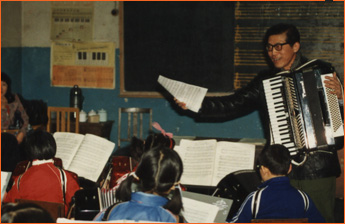
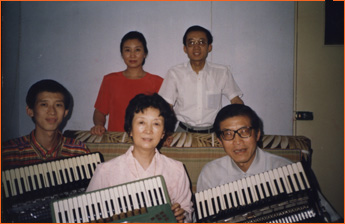
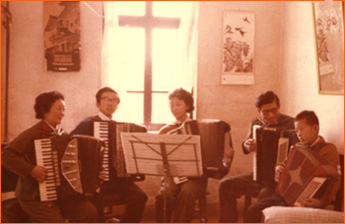
Mrs.
Zhang and son accompanying
Chinese Choir in 1980
|
|||||||||
|
|
|||||||||